


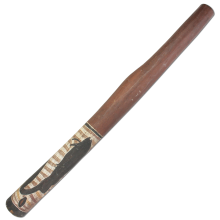
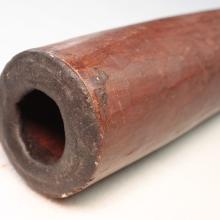
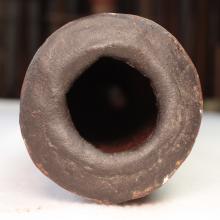
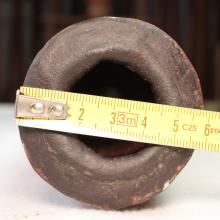
Mago Maningrida MN47
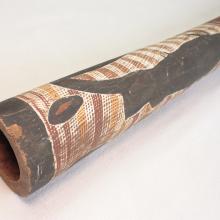
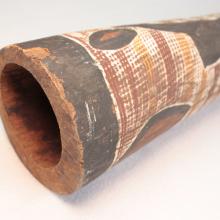
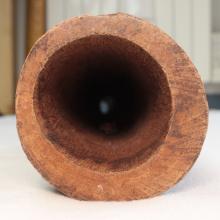
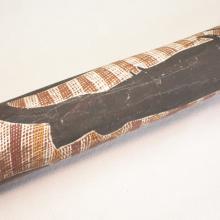
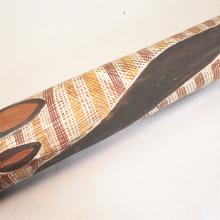
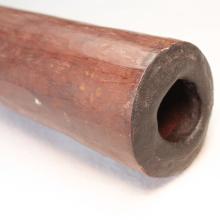
My Comments: Most didgeridoo enthusiasts are familiar with yidaki and its place in the culture of northeastern Arnhem Land. But fewer people have heard of Mago. The mago is a variation of the didgeridoo, made and used in the western parts of Arnhem Land. The length is made for the accompaniment of songs in one of two styles: the bunggurl style of the East or kunborrk tradition of the West. What is magical about this type of instrument is that it is also possible to play other styles of playing than necessarily the traditional one. This is due to the very good work of the air column. This gives the instrument a full, harmonic-rich sound, while still retaining an organic and “termite-crude” tone. I draw your attention to the fact that these instruments are painted with ocher, natural pigments and are not varnished either inside or outside. Some may have a few small cracks present at the bell, but they are all playable. Remember that these are “Vintage” instruments and most of them are over 40 years old!! It's a real blessing to be able to obtain such instruments these days!
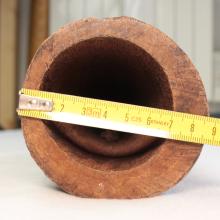
Following my merger with AboriginalArts UK, I was able to acquire the entire collection of Bear, the owner of AboriginalArts. This is a vintage mago from the Maningrida region dating from the 1970s. This is a museum-quality instrument that combines the production quality of magos from the 70s to 80s with a true traditional voice that is over 50 years old. A very open mago. Superb ochre painting of a very rarely used subject, the catfish, blackwax sugarbag mouthpiece. Instrument still in playable condition!
- Shipping costs are free! (only for France)
- The carrying case is free!
Classification
This scale is the result of an air column/bell start ratio If we divide the diameter of the bell with that of the beginning of the air column we get a number between 1.5 and 3.5. We can classify all the didgeridoos in 4 large families. Each family groups the instruments with a similar character, simply based on the overall shape of the air column (conical/cylindrical) and on the diameter of the column (wide/narrow). The result is a simple and very reliable reading grid, making it easier to search and purchase on line.
The diameters are measured with a caliper, start of the air column after the mouthpîece. This ratio is very reliable for a didg having a air column with a 'smooth' internal work, in the case of a hollowed eucalyptus instrument it give an approach of the instrumental character.
Mago
The mago is another kind of "traditional" didgeridoo, made from a eucalyptus hollowed out by termites.
What is a mago?
The mago is a type of traditional didgeridoo from western Arnhem Land. The word is used by several language groups whose country stretches from the Gunbalanya (Oenpelli) community in the west to the Blyth River east of Maningrida, and south towards Katherine.
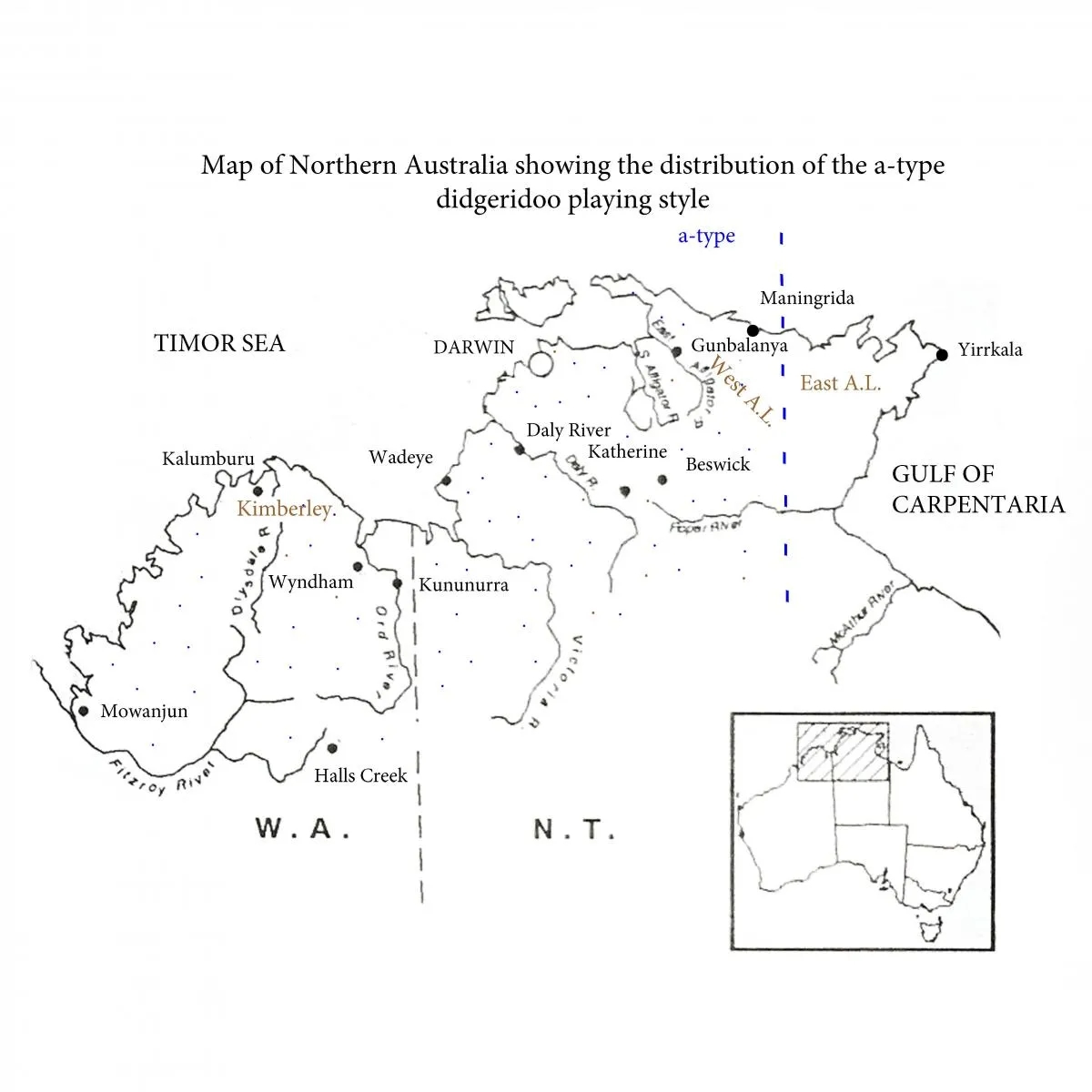
The word "mago" has become a generic name commonly used for the instruments played in this region. Its use even extends beyond western Arnhem Land: many didgeridoo enthusiasts use it for traditional didgeridoos made outside north-east Arnhem Land, that is, all Top End didgeridoos that are not yidakis.
The name "mago" is most often used for shorter, cylindrical traditional instruments.
This style is characterised by a drone without any "toot" (the trumpet sound), and by melodic overtones created by the player's voice over the drone. Mago-type didgeridoos also tend to have an open inner bore which, combined with the use of the vocal cords, gives their sound a melodic character.
Like other traditional instruments, the mago is used as rhythmic accompaniment for traditional songs.
Care: like the yidaki, the mago needs regular, preventive care to last a lifetime! To avoid cracks and give the wood time to return to a proper moisture level, I recommend reading the Advice and Accessories pages.