
Bruce Rogers

Didgeridoo maker since 1994!
Today Bruce is recognised and respected for the quality of his instruments and the reliability of his work.
Bruce Rogers, who is he?
Bruce Rogers is a didgeridoo maker, player and teacher. He is considered one of the best didge makers in Australia. Born in Brisbane in 1964, he grew up in Melbourne, where he worked as an engineer. Bruce started playing the didgeridoo in 1985. He has played across much of Australia and has also made many trips to Europe. Bruce began teaching the didgeridoo in 1990 and is known for his precise and fun method.
Since 1994, Bruce has worked full time as a didgeridoo maker. After making his first didgeridoos in 1992, he earned a reputation for making loud, clear instruments that suit experts and beginners alike. Today his didgeridoos are highly sought after in Australia and all around the world. Bruce's aim is to build the link between past and present, promoting the didgeridoo as an instrument for all ages, cultures and people.
How does Bruce make his didges?
- Bloodwood (Eucalyptus polycarpa)
- Messmate-Stringybark (Eucalyptus tetrodonta)
- Box (Eucalyptus normantonensis)
- Red Ironbark (Eucalyptus crebra)
- Woollybutt (Eucalyptus longifolia)
Each instrument is worked by hand and has a magnificent finish. A varnish enhances and protects the beauty of the wood. Each didgeridoo has a special mouthpiece made from a wax/ochre mix and carries a serial number inside the bell.
|
The raw eucalyptus logs are all termite-hollowed (naturally hollowed out by termites) and cut under licence from the Queensland state government. He takes care to cut only the trees he is going to use. The wood is then stored for a year in a special room with controlled conditions. |
|
An important moment, giving the didge its note and individual characteristics. a) He tunes each didge by shortening the wood. Different shapes and lengths produce different sound qualities, and the cuts bring out the best of what nature has provided.
b) The cavity hollowed out by the termites is opened up to form a bell and refine the tuning. |
|
Here Bruce removes the bark from the wood. The log has dried for twelve months after cutting. This wood is a Messmate-Stringybark (Eucalyptus tetrodonta). |
|
Excess wood is planed off the outside to reduce the weight and improve resonance. Bruce uses hand tools and reduces the wall thickness gradually until the didge starts to "sing". |
|
Bruce uses several grades of sandpaper to smooth the outside. Finally, a clear coat gives protection and enhances the beauty of the wood. A mouthpiece is fitted and the didge is numbered. |
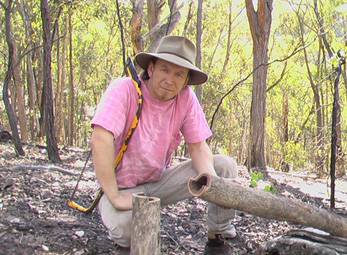 1. The timber
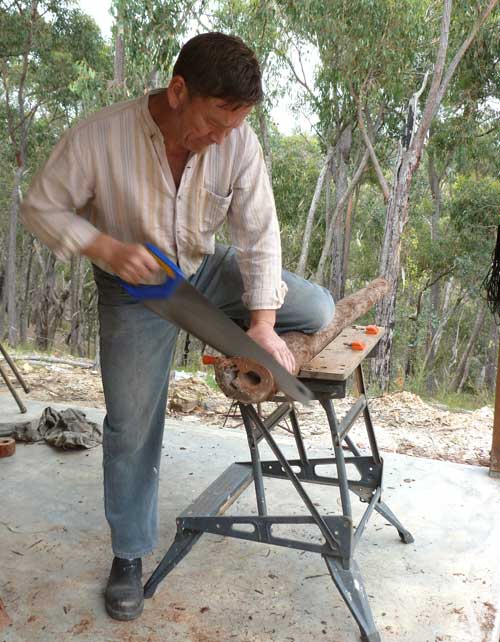 2. Tuning the didge
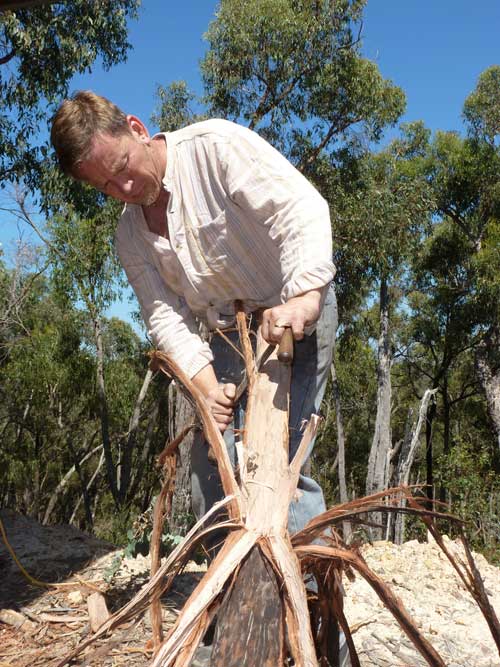 3. Stripping the bark
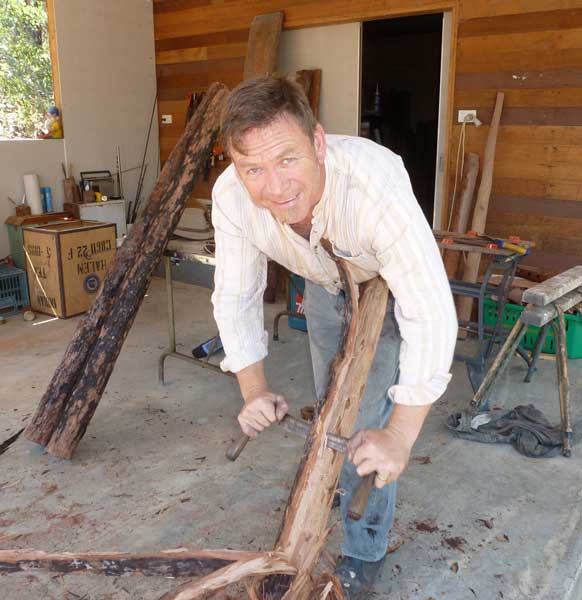 4. Shaping the didge
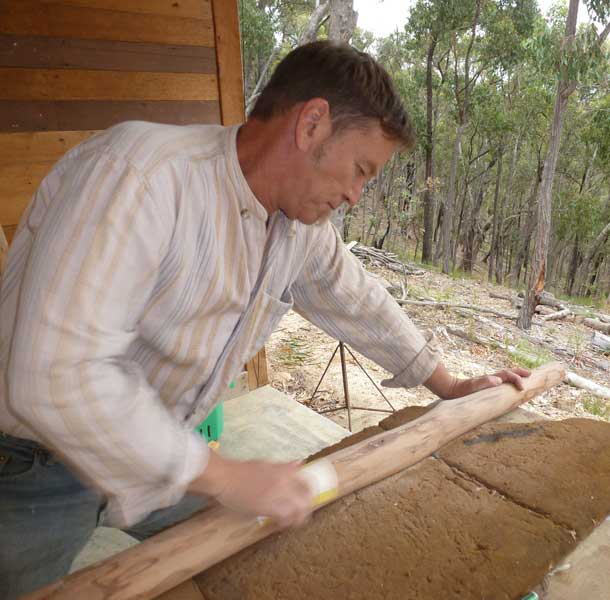 5. Finishing (the most repeated operation!)
Care: Bruce's didgeridoos do not require preventive maintenance. Please do, however, take certain precautions and look after it regularly so that your instrument lasts a lifetime! You can refer to the advice page.