


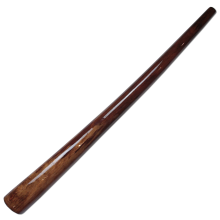
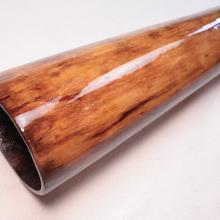
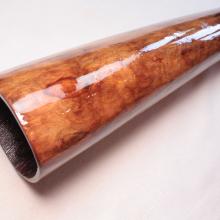
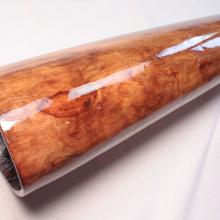
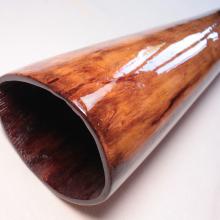
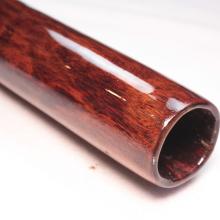
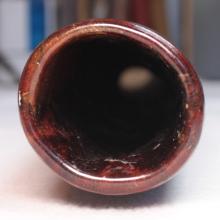
- Shipping costs are free! (only for France)
- The carrying case is free!
Classification
This scale is the result of an air column/bell start ratio If we divide the diameter of the bell with that of the beginning of the air column we get a number between 1.5 and 3.5. We can classify all the didgeridoos in 4 large families. Each family groups the instruments with a similar character, simply based on the overall shape of the air column (conical/cylindrical) and on the diameter of the column (wide/narrow). The result is a simple and very reliable reading grid, making it easier to search and purchase on line.
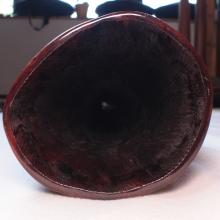
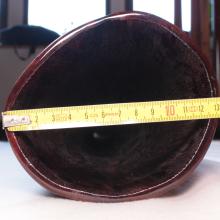
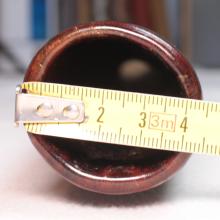
The diameters are measured with a caliper, start of the air column after the mouthpîece. This ratio is very reliable for a didg having a air column with a 'smooth' internal work, in the case of a hollowed eucalyptus instrument it give an approach of the instrumental character.
Yidaki
The yidaki is the "traditional" didgeridoo of the Yolŋu, made from a eucalyptus hollowed out by termites.
What is a yidaki?
The yidaki is the so-called "traditional" didgeridoo of the Yolŋu. It is made using ancestral methods by an experienced Aboriginal maker from Arnhem Land (in the north-east of the Northern Territory), and it is usually painted with the designs of the maker's clan.
What most often sets a yidaki apart from a didgeridoo is the shape of the air column. The inside of a yidaki is generally narrower and hardly reworked at all. The sound is raw and compressed: the result is a very responsive instrument, with hoots that are easy to reach.
If you choose to buy a yidaki from Didgeridoo Passion, you can be sure of receiving an authentic, high-quality instrument. The yidakis I offer come from the Yirrkala community and the Buku-Larrŋgay Mulka art centre. They are authentic traditional instruments, made by Aboriginal makers and imported directly from Arnhem Land, Australia. Each yidaki comes with its certificate of authenticity and the biography of its maker!
How are they made?
The vast majority of yidakis from north-east Arnhem Land are made from one of these eucalyptus species:
- "Gadayka", Stringybark (Eucalyptus tetrodonta)
- "Gungurru", Woollybutt (Eucalyptus miniata)
- "Badawili", Bloodwood (Eucalyptus ferruginea)
These trees are hollowed out naturally by termites. The techniques for finding and making a yidaki vary from one artist to another. The maker starts by removing a piece of bark, then strikes the trunk with the back of an axe to hear whether it sounds hollow. Thanks to their experience, makers can tell whether the cavity is right for a yidaki, and choose the best place to cut the tree.
The trunk is then trimmed to get the right mouthpiece size. The ideal inner diameter is around 30 to 35 mm. Sometimes the mouthpiece is wider: in that case, the artist considers that the yidaki will sound good with a little wax.
The Buku-Larrŋgay Mulka museum and art centre
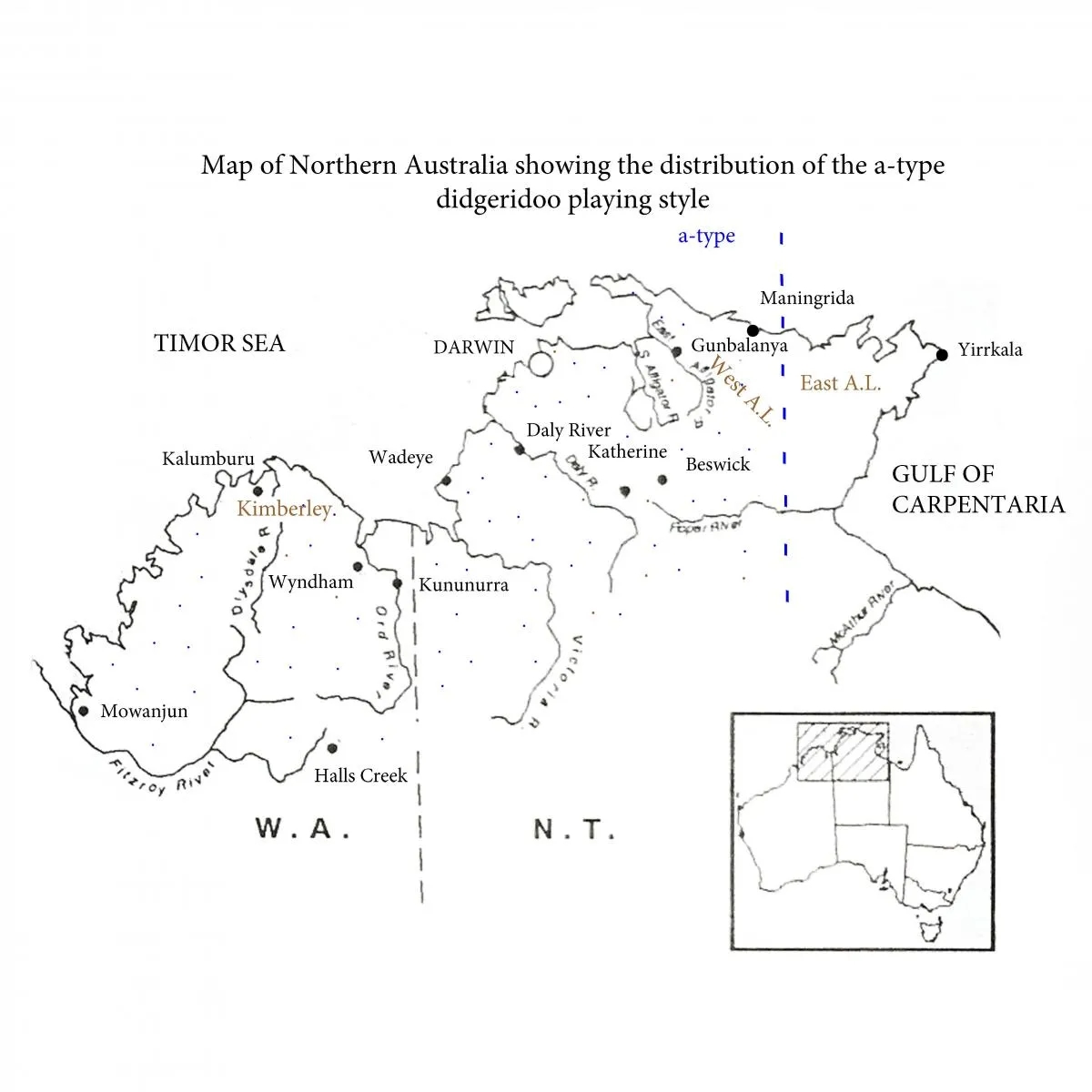
The Buku-Larrŋgay Mulka art centre is located in Yirrkala, a small Aboriginal community in the north-east of the Northern Territory, about 700 km east of Darwin.
Yirrkala Arts was officially founded in 1975. In the 1960s, Narritjin Maymuru had opened his own gallery near the beach, from which he sold Aboriginal art that now graces many major museums and private collections. He is one of the founders of the art centre. His idea of selling Yolŋu art, born under a simple beach shelter, has grown into a thriving business: since 2005, the centre has paid more than a million dollars a year to the community's artists.
Yirrkala's former hospital, where many of these artists were born, was converted into the "craft shop". Over the years the building has been extended and renovated several times, so much so that today's centre bears little resemblance to its beginnings: museum (1988), screen-printing workshop and new galleries (1996), Yirrkala Church Panels annex (1998), multimedia centre (2007).
The Buku-Larrŋgay Mulka museum holds a collection of works created especially by the elders in the mid-1970s and early 1980s. They give an insight into the structure of Yolŋu kinship. The jewels of the collection are the two four-metre-high Yirrkala Church Panels (1962-1963), regarded as among the most important paintings ever made in Australian art.
Care: a yidaki needs regular, preventive care to last a lifetime! To avoid cracks and give the wood time to return to a proper moisture level, I recommend reading the Advice and Accessories pages.