


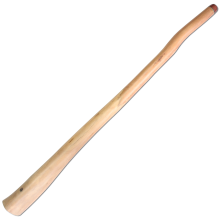
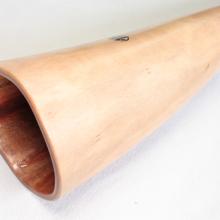
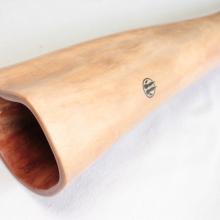
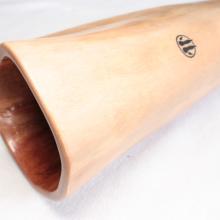
Wix Stix 0552
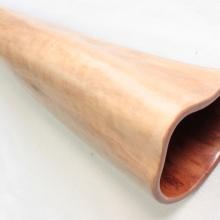
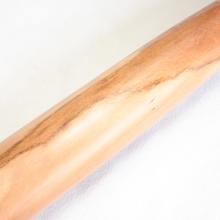
In short: A didgeridoo in very pale boxwood, in D, versatile and well balanced. It is part of the Gauthier Aubé Selection.
Comments from Gauthier Aubé: A didgeridoo that is neither too open nor too closed, despite its pronounced taper. It is versatile across many techniques and so just as comfortable with tongue playing as with cheek playing. To put it simply: a well-balanced didgeridoo.
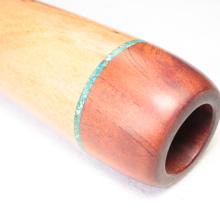
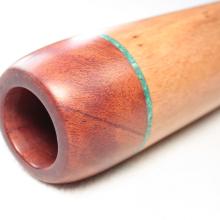
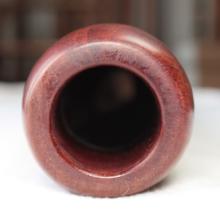
This didgeridoo: The mouthpiece is in red cedar, with a chrysocolla inlay, a stone said to have soothing properties. This didgeridoo is surprising: its very pale colour is unusual for boxwood, and that is what makes it so elegant. It is Bruce's favourite from the latest delivery.
The maker: Bruce has been making didgeridoos since the mid-90s, and his passion is intact thirty years on. He puts quality before quantity: his trunks dry for at least 12 months before being worked.
He does not use wax to reduce the mouthpiece: he works it directly in the wood or fits an insert, for real playing comfort. In my eyes, the balance between build quality, finish, playability and price is unbeatable.
The Gauthier Aubé Selection: Gauthier is a long-standing friend and, in my eyes, one of the most inspiring musicians on today's didgeridoo scene. He chooses the didgeridoos in the shop that he values for their balance, playing comfort, richness of sound and precision. Below you will find a video of him playing this instrument.
- Instrument guaranteed for 1 year
- Shipping is free! (France only)
- Didgeridoo Passion also offers you the carry bag free
Classification
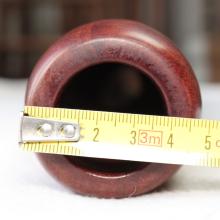
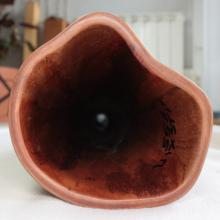
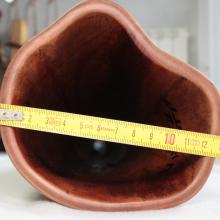
This scale is the result of an air column/bell start ratio If we divide the diameter of the bell with that of the beginning of the air column we get a number between 1.5 and 3.5. We can classify all the didgeridoos in 4 large families. Each family groups the instruments with a similar character, simply based on the overall shape of the air column (conical/cylindrical) and on the diameter of the column (wide/narrow). The result is a simple and very reliable reading grid, making it easier to search and purchase on line.
The diameters are measured with a caliper, start of the air column after the mouthpîece. This ratio is very reliable for a didg having a air column with a 'smooth' internal work, in the case of a hollowed eucalyptus instrument it give an approach of the instrumental character.

Bruce Wix Stix
Bruce Wix, maker of Wix Stix didgeridoos
A passionate maker who takes his time: quality before quantity!
Bruce started making didgeridoos in the mid-1990s, and his passion is still as strong thirty years later! He works with three types of eucalyptus:
- Woollybutt
- Ironbark
- Box
All his termite-hollowed logs come from northern Queensland and are cut by a renowned Aboriginal traditional owner. They dry for at least twelve months before being worked. Bruce does not use wax to reduce the diameter of his mouthpieces.
Either the natural hole is the right diameter, in which case Bruce shapes the mouthpiece directly in the wood, or he fits a camphor laurel mouthpiece, a wood known for its antibacterial qualities. As far as I know, Bruce is the only maker to use this kind of insert: a real plus for a mouthpiece that is both very comfortable and antibacterial.


