


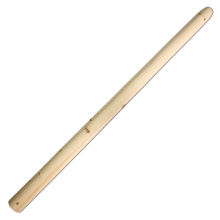
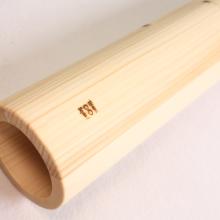
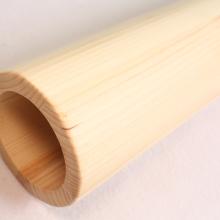
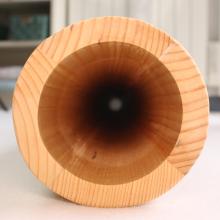
In short: A Triton Squad didgeridoo from the Atlante range, in spruce, in C: an open bore, easy to play, for starting out or progressing on a limited budget.
The Atlante range: Whether you are a beginner or a player on a limited budget, this instrument will suit you perfectly. Its open bore lets you progress easily and quickly: it is the new benchmark for learning didgeridoos!
The maker: Didgeridoo Passion is delighted to team up with Triton Squad, alias Mitch. I had long been looking for a didgeridoo with a so-called "open" bore without a huge price tag. Mitch developed the Atlante range alongside his other ranges.
I am really surprised by its playability and how easy it is to play: Mitch has kept a certain wall thickness without making the instrument heavy. At this price level, the finish is excellent.
Mitch uses hard oil, which makes it possible to personalise the didgeridoo: if you want to paint it to your taste, you can!
How it is made: The inside of the bores is worked on a CNC milling machine. Milling is a machining process that removes material in the form of chips: the cutting tool rotates while the workpiece or the tool advances.
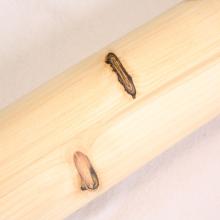
This process makes it possible to control the design, and so the type of bore, and to define a note and a playability precisely. Even though the machining is identical from one instrument to the next, each didgeridoo remains unique in the grain and colour of its wood.
Mitch's comments: Here is the Atlante range of didgeridoos, the fruit of several years of work and experience with the instrument, serving beginners and those who want to improve, with a simple, pleasant playing experience and a round, precise, pleasing sound.
The air column is machined using a modern technique that allows flawless dimensional precision. It is designed so that the didgeridoo is versatile, accessible, precise and responsive. You will very easily produce wobble, beatbox, overblows and vocals.
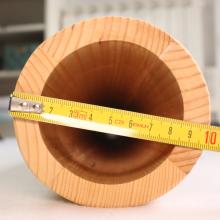
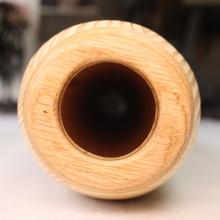
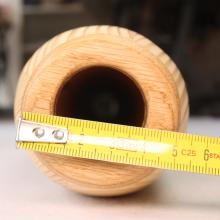
These instruments were designed to be the benchmark French learning didgeridoo. The air column is said to be open, 45 mm at the mouthpiece outlet, which gives the instrument (among other factors) detailed harmonics and powerful bass, with very simple playability.
As for the choice of wood (spruce for this range), I think, as a didgeridoo maker, that softwoods have a bad reputation because of poor information. For the record, Stradivarius violins are made of spruce…
It is true that the wood is less dense and, to make up for this "shortcoming" that isn't really one, I leave more thickness.
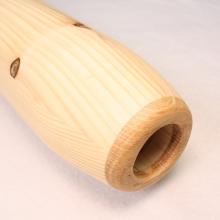
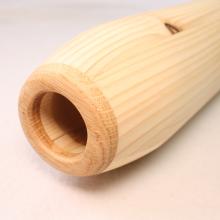
Body: spruce / Mouthpiece: oak
- Shipping is free! (France only)
- Carry bag free!
The video: The video does not show the instrument on sale: it is a representative sample of the Atlante range. The photos, however, show the actual instrument that will be delivered to you. We do not make a video for each instrument in the range.
Classification
This scale is the result of an air column/bell start ratio If we divide the diameter of the bell with that of the beginning of the air column we get a number between 1.5 and 3.5. We can classify all the didgeridoos in 4 large families. Each family groups the instruments with a similar character, simply based on the overall shape of the air column (conical/cylindrical) and on the diameter of the column (wide/narrow). The result is a simple and very reliable reading grid, making it easier to search and purchase on line.
The diameters are measured with a caliper, start of the air column after the mouthpîece. This ratio is very reliable for a didg having a air column with a 'smooth' internal work, in the case of a hollowed eucalyptus instrument it give an approach of the instrumental character.

Triton Squad
French maker of "Triton Squad" didgeridoos
Who is Mitch?
Mich, or Mitch, started music at the age of 10, learning the trumpet at his village music school. An all-rounder, he also enjoyed playing the clarinet and the synthesiser. In 1999, aged 18, he made his first trip to Australia to visit his godparents. They introduced him to an instrument little known in France at the time: the didgeridoo. He fell for it immediately and came home a few weeks later with his first didgeridoo under his arm.
Completely self-taught, he persevered and took on the challenges of this ancestral and sacred instrument one by one. Passionate and always looking for new sounds, he built up a real forest of didgeridoos, often leaving those around him puzzled by the number of his instruments. People regularly even ask him whether Triton Squad is an association of didgeridoo players… He answers no: he is on his own, and happy. His dream: to reach 100 didgeridoos by the end of his life. He also sometimes makes his own instruments, which delights him no end.

What is Triton Squad?
In 2013 his level allowed him to set up his business, Triton Squad, to share his passion and introduce the didgeridoo to as many people as possible. It offers five types of services: concerts, educational sessions, vibrational sound care, private lessons, and making and selling didgeridoos. Mitch wants to work with children and teenagers to share with them the peaceful values linked to playing his instrument. To work in schools, he has been approved as an external music education provider for the Haut-Rhin and Bas-Rhin departments.
In May 2017 he "competed" against the best European players at Didg à Didg no. 4, reaching the round of 16.
In 2019, at Didg à Didg no. 5, which became international with the arrival of two Mexicans, a Peruvian and an Iranian, Mitch finished this peaceful competition in the semi-finals, among the top four registered players.