


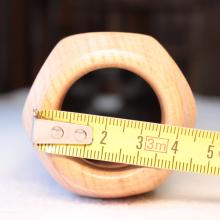
HexSpira Feather
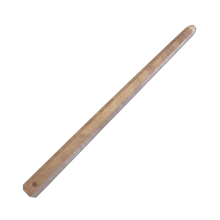
In short: A HexSpira didgeridoo from the Plume range, in E: light, simple and inexpensive, with an open bore, for starting out or playing on a small budget.
The Plume range: Whether you are a beginner or a player on a limited budget, this instrument will suit you perfectly. Its open bore lets you progress easily and quickly. It is the new benchmark for learning didgeridoos: light, simple and inexpensive.
Its low weight also makes it perfect for playing on the move, during massages or sound journeys.
The maker: I am delighted to team up with HexSpira, all the more so as I made hexadidges myself in the past: I know very well how rigorous this type of design is. In fact, I had never taken angled gluing as far as Colas does.
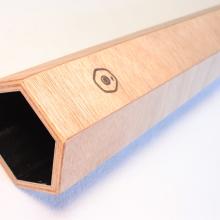
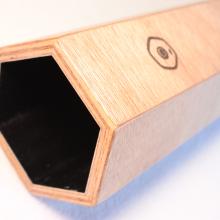
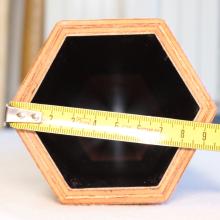
For the Plume range he uses a so-called "marine" plywood, in poplar and okoume, which offers exceptional dimensional stability and resistance to humidity. It cannot crack, and makes it possible to create didgeridoos much lighter than the classic ranges.
Colas has succeeded in creating real bores of his own, with incredible sound and playability!
Why the Plume range? I had long been looking for a didgeridoo with a so-called "open" bore without a huge price tag. Colas developed the Plume range alongside his other ranges. I am really surprised by its playability and how easy it is to play.
The open bore gives the instrument, among other factors, detailed harmonics and present bass, with very simple playability. At this price level the finish is excellent: Colas uses a polyurethane varnish.
This didgeridoo is designed to be versatile, accessible, precise and responsive: you will very easily produce wobble, beatbox, overblows and vocals.
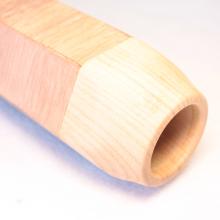
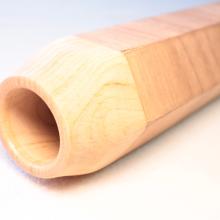
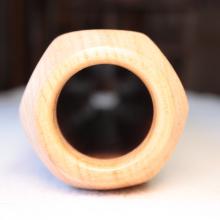
Body: so-called "marine" plywood in poplar and okoume / Mouthpiece: maple
- Instrument guaranteed for 1 year
- Shipping is free! (France only)
- Didgeridoo Passion also offers you the carry bag free
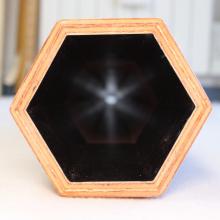
Photos and video: The photos and the video do not show the instrument that will be delivered to you: they are a representative sample of the Plume range. Rest assured, the quality of the instrument delivered is strictly identical. To save time and keep costs down, we do not take photos or make a video for each instrument in the range.
Classification
This scale is the result of an air column/bell start ratio If we divide the diameter of the bell with that of the beginning of the air column we get a number between 1.5 and 3.5. We can classify all the didgeridoos in 4 large families. Each family groups the instruments with a similar character, simply based on the overall shape of the air column (conical/cylindrical) and on the diameter of the column (wide/narrow). The result is a simple and very reliable reading grid, making it easier to search and purchase on line.
The diameters are measured with a caliper, start of the air column after the mouthpîece. This ratio is very reliable for a didg having a air column with a 'smooth' internal work, in the case of a hollowed eucalyptus instrument it give an approach of the instrumental character.
HexSpira
French maker of "HexSpira" didgeridoos
Who is Colas?
"I am a didgeridoo player, hooked on this mysterious instrument since we met in 2006. First a curiosity, then a passion and a way of life: the didgeridoo has accompanied and guided me all these years, through encounters and street shows.
Throughout my journey as a musician, I have made didgeridoos that helped me progress in my playing and in my understanding of the instrument. I started with the usual 'sandwich' method, which consists of hollowing out two pieces of wood and gluing them back together. Not satisfied with this method, I wanted to go further and created HexSpira didgeridoos, developing a new technique and a very different approach to making.
Why this hexagonal shape?
I make my didgeridoos by gluing together six wooden staves with chamfered edges, for a perfect fit. It is the profile of these staves that determines the inner geometry of the air column. The different sections of the instrument, wider, narrower or flared, are 'contained' in the shape of the staves. So the inner geometry appears when the staves are glued, with perfect precision, and it is this geometry that determines almost all the didgeridoo's characteristics in terms of key and playability.
This technique allows me to do two things:
- fine-tune the air column of each instrument to perfection, through successive trials, to achieve a perfect sound and playability;
- reproduce them identically thanks to making templates, so as to offer only perfectly finished instruments, without any flaws.
This geometric precision is inherent in the hexagonal assembly. With the 'sandwich' method, reaching a comparable level of precision takes much more care and time. That is why I can offer high-end didgeridoos at much lower prices than their traditionally made equivalents, making them accessible to as many people as possible.
Plywood, why?

Plywood is made of very thin layers of wood glued on top of each other, with the grain direction alternating. HexSpira didgeridoos are made from birch plywood, the top of the range of wood panels in terms of mechanical strength and density.
The cross structure of this material prevents any movement of the wood and, above all, makes cracking impossible. They are the only didgeridoos that offer both the warm sound of solid wood and a sturdiness usually found only in synthetic didgeridoos.
And what about the sound?
The sound of the didgeridoo is at the heart of my approach: it is what drives me and what I love! Between their hexagonal shape and their material, HexSpira didgeridoos are out of the ordinary in many ways, and it is fair to wonder whether the sound quality lives up to it. Over time I have become very demanding about the sound and characteristics of my didgeridoos. Today, the ones I make fully satisfy me as an experienced and demanding player. I'll let you judge for yourself, by listening to the recordings or coming to try them!" Colas