



Gunbarrk, Bolda Hunter
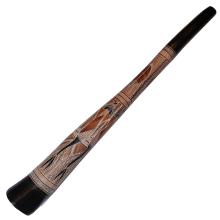
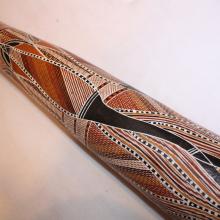
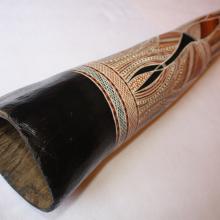
Here is a very special instrument: a Gunbarrk, the traditional name of the didgeridoo in the language of the Jawoyn. A collector's piece and a vintage instrument. I was able to obtain it thanks to Joe Hagarty, who spent the last 10 years with Bolda Hunter and his family, learning to live in the bush, hunt, fish and above all cut and make didgeridoos. Joe got this instrument from Bolda, who had made it several years earlier and kept it as a collector's piece because of its size and the fineness of its painting.
Who is Nigel Bolda Hunter?
A white man adopted into the community, Bolda's real origins are not known. But we do know that he lived for more than two decades with the Jawoyn clan and other clans of Arnhem Land. He had the good fortune to be initiated by the Jawoyn elders. To this day Bolda still lives in Arnhem Land in a traditional way of life. He is renowned for the excellence and fineness of his paintings and for the authentic stories they tell. His art is highly sought after and exhibited nationally and internationally. He is one of the finest representatives of the Gunbarrk and makes high-quality instruments. Today it is very difficult, if not impossible, to find other Gunbarrk by Bolda.
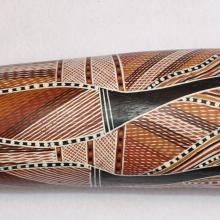
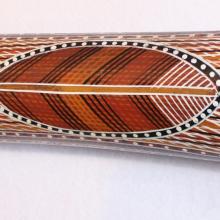
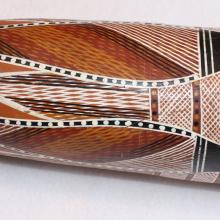
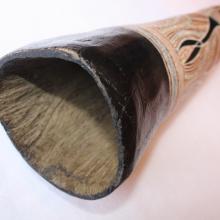
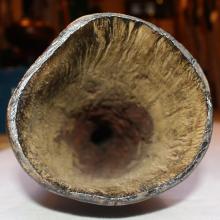
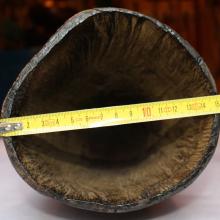
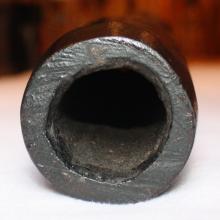
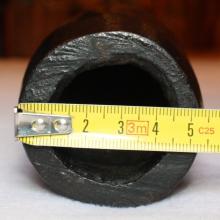
My comments: Here is the opportunity to own a vintage instrument with an extremely fine painting. Beyond being a collector's piece, this instrument is also a great player. With a bell of more than 13.5 x 12.5cm, it is simply huge. The natural mouthpiece is a little large, but it can be reduced with a little wax. The story painted on the instrument is "Nhal Warri Warri", which means the power of the Mermaid Dreaming. A powerful instrument, both in its meaning and in its playability!
- Shipping is free! (France only)
- The carrying bag is included free of charge!
| Archive photo: Joe Hagarty, Bolda with the Gunbarrk | Nigel Bolda Hunter |
 |
 |
| Source THE ABORIGINALS |
Classification
This scale is the result of an air column/bell start ratio If we divide the diameter of the bell with that of the beginning of the air column we get a number between 1.5 and 3.5. We can classify all the didgeridoos in 4 large families. Each family groups the instruments with a similar character, simply based on the overall shape of the air column (conical/cylindrical) and on the diameter of the column (wide/narrow). The result is a simple and very reliable reading grid, making it easier to search and purchase on line.
The diameters are measured with a caliper, start of the air column after the mouthpîece. This ratio is very reliable for a didg having a air column with a 'smooth' internal work, in the case of a hollowed eucalyptus instrument it give an approach of the instrumental character.