


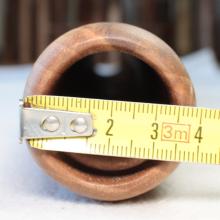
Duende Walnut Magius
Duende Golden (master)
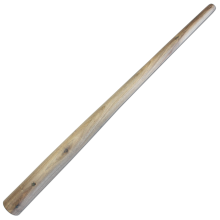
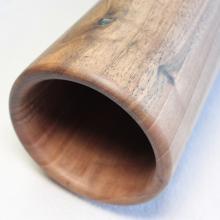
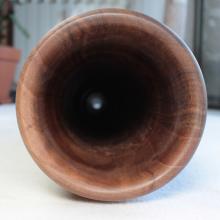
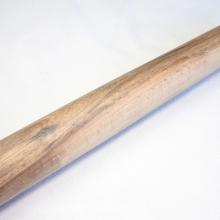
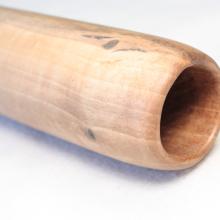
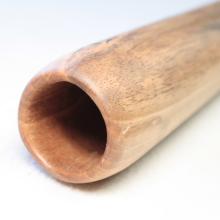
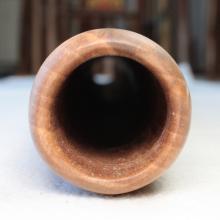
In short: A gold class (master) Duende Magius didgeridoo in E, carved from a single piece of walnut. Compact and light, very versatile, with a full sound and remarkable playing comfort.
This didgeridoo: The Magius is Dubravko's flagship model. This E version is compact and light: 153 cm for 2.4 kg.
It has all the demands you expect from a gold class Duende: precise tuning and a careful finish. A professional-quality instrument, at ease in rhythmic playing as well as in toots.
Comments from Dubravko Lapaine: Magius is our top-of-the-range model. It was born from the Sumo, keeping its incredible playing comfort and its full, round air pulses, backed by excellent back pressure.
We improved it on two points that matter a lot to me: precision, to articulate well at high speed, and the toots. It was tested and refined for more than two years.
This Magius in E is a beautiful little didgeridoo, incredibly versatile: it stands somehow in the middle of all the didgeridoo playing techniques. I use this E didgeridoo every day. It is one of the cornerstones of what didgeridoo playing is, and one wouldn't expect that amount of possibilities and fullness in an E.
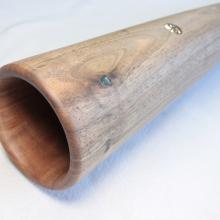
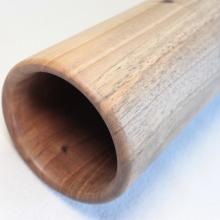
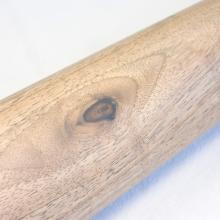
The Magius variation adds some punch, compactness and grit. The feeling of playing is extremely comfortable and natural. It is made in one piece from walnut.
- Duende Magius: Gold class (master) / matte finish, epoxy impregnated with water-based PU
- Shipping is free! (France only)
- Didgeridoo Passion also offers you the carry bag free
Classification
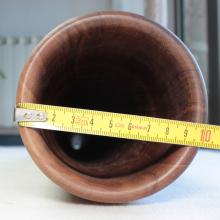
This scale is the result of an air column/bell start ratio If we divide the diameter of the bell with that of the beginning of the air column we get a number between 1.5 and 3.5. We can classify all the didgeridoos in 4 large families. Each family groups the instruments with a similar character, simply based on the overall shape of the air column (conical/cylindrical) and on the diameter of the column (wide/narrow). The result is a simple and very reliable reading grid, making it easier to search and purchase on line.
The diameters are measured with a caliper, start of the air column after the mouthpîece. This ratio is very reliable for a didg having a air column with a 'smooth' internal work, in the case of a hollowed eucalyptus instrument it give an approach of the instrumental character.

Duende
Dubravko Lapaine and Danka Tišljar, makers of "Duende" didgeridoos
Here is something I have never done before, but to introduce the subject, I am going to compare the world of didgeridoo makers to the world of cars. With cars, you find all sorts of brands, finishes and engine sizes, all with the same goal in the end: to take us from point A to point B. Yet you will all agree that the comfort is not the same in a Citroën 2CV and in a Ferrari… Well, it is the same with the didgeridoo: the aim is always to convey a vibration.
After twenty years of playing, hundreds of didgeridoos tried and meetings with a great many makers, I now have enough perspective to tell you: if I had to name the Ferrari of didgeridoos, it would be Dubravko Lapaine's Duende. To really understand the characteristics of a didgeridoo, and therefore to be a good maker, you first have to be a good player.
You can see where I am going with this: Dubravko is recognised as one of the best technicians in the world. He is so demanding of himself that you can feel it in every one of his instruments. Why are Duende, in my opinion, the best didgeridoos you can find? It cannot be summed up in one sentence.
It all starts with the drilling process, which Dubravko has mastered to perfection: no cutting or gluing, for much better control of the dimensions. Imagine drilling perfectly straight over more than two metres…
Then comes the choice of wood. Here again Dubravko leaves nothing to chance: he uses the densest woods there are, to contain the vibration as much as possible and offer an extraordinary richness of overtones and playability. But there is a downside: the tools have to be sharpened over and over again, which means a huge amount of work…
There is also the internal configuration of the air columns. Dubravko has developed his own configurations over the years and through his concerts: first and foremost he makes instruments for himself, seeking the best balance between subtlety of sound and technique, so as to perform every playing technique and every sound.
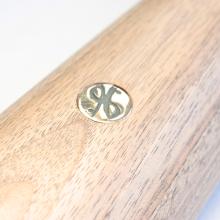
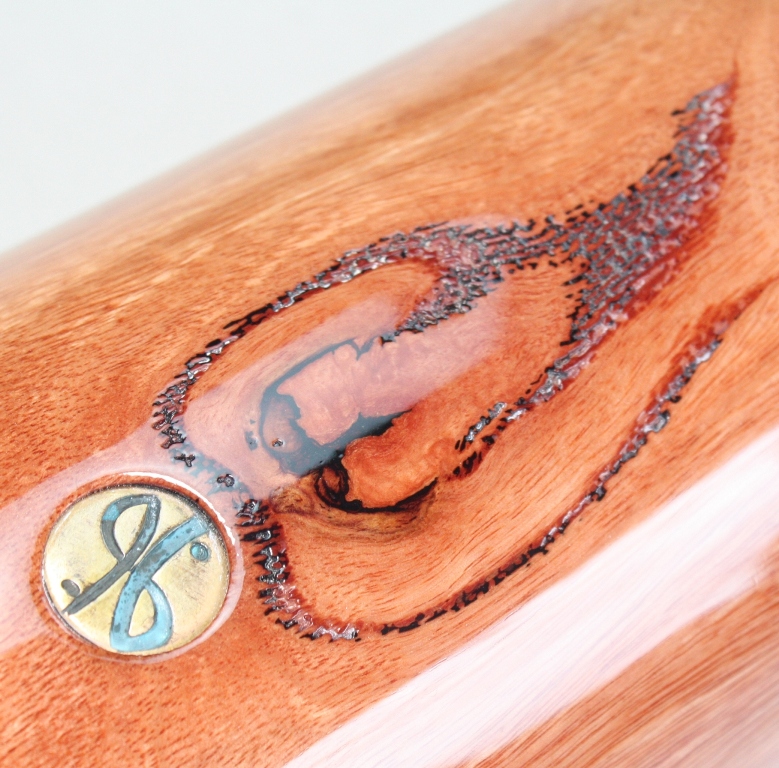
Finally, there is the finish, inside and out. A beautiful paint job makes an immediate impression on a car, and the same goes for a didgeridoo. Each Duende is truly unique: they are real collector's pieces. If you have ever held a Duende in your hands, you will understand what I mean. Inlays, engraving, pyrography and many other techniques add enormous value and bring the instrument to life.
I hope these words help you understand the value of Duende didgeridoos. So yes, Duende are not cheap, but after what I have just written, you can probably appreciate the exceptional value of these instruments. Just like a Ferrari, it is a treasure you treat yourself to for an ultimate passion: unique craftsmanship, for unique design, playability and finish!