


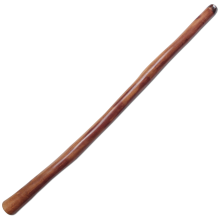
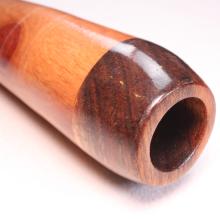
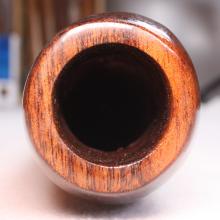
In short: A genuine eucalyptus didgeridoo, in C#, from the Budget O'Meara range: a quality instrument, easy to play, for a moderate budget.
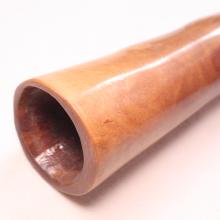
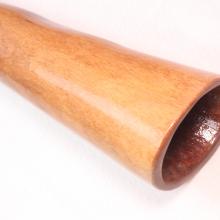
The Budget O'Meara range: Budget O'Meara didgeridoos are all handmade, with the help of a few power tools for sanding. The outside is protected by several coats of polyurethane lacquer, flexible and UV-resistant. All have an added mouthpiece in camphor wood.
Why this range? To give as many people as possible access to a genuine, quality termite-hollowed eucalyptus instrument, for a moderate budget.
What is the difference from the Top class? Mainly the type of trunk. Budget and Top instruments come from the same wood harvests, but the demands of the Top class led Tristan to set some trunks aside: their air column, and very often their length, did not allow a Top-class instrument to be made from them.
With these trunks he launched the Budget class: ideal for starting out with a quality instrument that is above all easy to play, or for getting your hand in on a versatile eucalyptus on a small budget.
At this price, Tristan cannot spend as much time on the finish: he does his best to make it decent, and gives priority to acoustic quality.
- Shipping is free! (France only)
- Carry bag free!
Classification
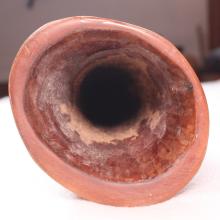
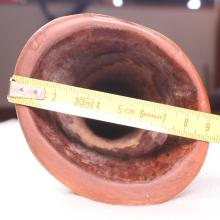
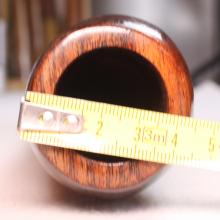
This scale is the result of an air column/bell start ratio If we divide the diameter of the bell with that of the beginning of the air column we get a number between 1.5 and 3.5. We can classify all the didgeridoos in 4 large families. Each family groups the instruments with a similar character, simply based on the overall shape of the air column (conical/cylindrical) and on the diameter of the column (wide/narrow). The result is a simple and very reliable reading grid, making it easier to search and purchase on line.
The diameters are measured with a caliper, start of the air column after the mouthpîece. This ratio is very reliable for a didg having a air column with a 'smooth' internal work, in the case of a hollowed eucalyptus instrument it give an approach of the instrumental character.
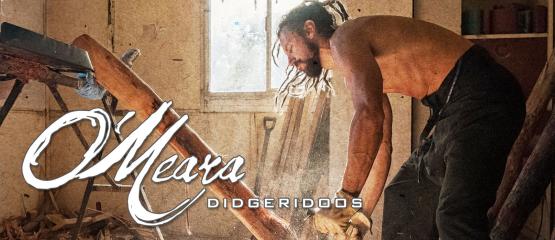
Tristan O'Meara
A musician at heart, Tristan has been making didgeridoos for many years
What started as a hobby has become his livelihood: making didgeridoos of the highest quality.
Who is Tristan O'Meara?
"My name is Tristan O'Meara. I have been a musician and singer-songwriter for many years, and I now live in Byron Bay, Australia. I was lucky enough to be introduced to the didgeridoo by Wuduri Wiriundjara, a renowned Aboriginal artist from the Cairns area.
Over time I have learned what each player needs from a didgeridoo, depending on their style: big stage, outdoor or indoor playing, acoustic solo, recording studio, street performance or travel! I do my best to find the instrument that suits each player best. All my instruments are made from the finest eucalyptus (the ones that don't suit me end up as firewood, and they burn very well…). Each didgeridoo is worked and carved while listening for its best resonance.
Back when I was learning didgeridoo techniques, I was looking for different keys to suit my music, but I couldn't afford to buy them all. So I decided to travel to the Northern Territory. There I was lucky enough to meet several traditional owners, who showed me how to make a didgeridoo and how to find good logs properly hollowed out by termites in the Australian bush. These people kindly shared their time, skills and knowledge with me. It was a long and often very difficult apprenticeship that lasted several years.
Over the years I have made didgeridoos with Aboriginal people, but also for renowned makers. I have spent countless hours perfecting my techniques, keeping everyone's ideas and improving my method day after day."
How are Tristan O'Meara didgeridoos made?
Tristan chooses his termite-hollowed eucalyptus logs and keeps only those that sound right. Each didgeridoo is then shaped by listening to its resonance, using hand tools and machine tools for the heaviest stages. The epoxy resin exterior finish protects the instrument and brings out the natural colours of the wood.