


Alex Didg
Alex's comments: I designed this didgeridoo with several objectives, to make an instrument easy to play, with a fairly well balanced sound, and with the first hoot tuned to the drone note. The result is a very versatile instrument, which allows both a beginner to easily get to grips with it and an experienced player to have fun and let loose without constraints. It's an instrument that many people like, and I therefore decided to offer it in other notes in order to satisfy the different requests (D/D, D#/Re#, F/F currently being tuned). )
- Instrument guaranteed for 2 years by Alex
- Shipping costs are free! (only for France)
- Free carrying case !
432Hz or 440Hz?
The overall sonic difference is noticeable, the 432Hz version sounds warmer, clearer and seems to be instantly more listenable, but the 440Hz version is tighter with more dynamic energy. Almost all Western music is currently tuned with A at 440 Hz. This means that all musical instruments, tuning forks, and music creation programs are tuned to this frequency.
Please note the video opposite does not present the instrument for sale, it is a representative video extract from the Othello Signature Range. However, the photos are contractual and correspond to the instrument that will be delivered to you.
Classification
This scale is the result of an air column/bell start ratio If we divide the diameter of the bell with that of the beginning of the air column we get a number between 1.5 and 3.5. We can classify all the didgeridoos in 4 large families. Each family groups the instruments with a similar character, simply based on the overall shape of the air column (conical/cylindrical) and on the diameter of the column (wide/narrow). The result is a simple and very reliable reading grid, making it easier to search and purchase on line.
The diameters are measured with a caliper, start of the air column after the mouthpîece. This ratio is very reliable for a didg having a air column with a 'smooth' internal work, in the case of a hollowed eucalyptus instrument it give an approach of the instrumental character.
Alex Didgeridoo
French didgeridoo maker using the "sandidg" method
Who is Alex?
"My passion for making didgeridoos came very naturally in 1994, when I discovered the instrument. I then made maple didgeridoos in the family woodworking workshop. But it was only many years later, on my first trip to Australia, that I became interested in Australian eucalyptus didgeridoos hollowed out by termites. Since then I have worked with many woods and developed different making techniques. Always curious about new woods, new finishes and new instruments, I keep enriching my skills and my range."
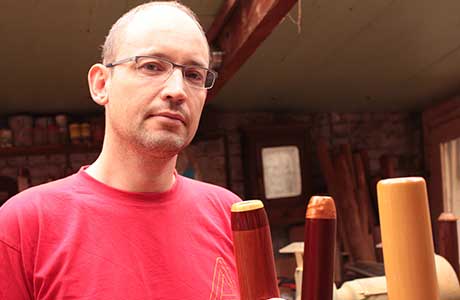
How does Alex make his didgeridoos?
"My technique consists of making the instrument in two parts, then gluing them together. The main feature of my 'sandwich' didgeridoos lies in the choice of wood: I don't start from a branch, as many do, but buy squared timber or boards, perfectly dry and carefully selected from high-quality woods. I carve both the inside and the outside entirely. This way of working lets me create any shape: my only limit is the size of the original piece of wood." Alex