


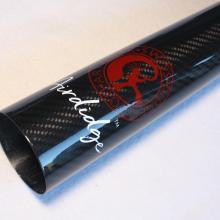

Airdidge
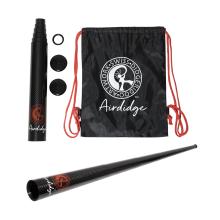
In short: A telescopic travel didgeridoo, 100% carbon fibre: 540 g, 37 cm collapsed, 186 cm extended, 3 keys. The pack includes the Airdidge, its bag, its caps and a microfibre cloth.
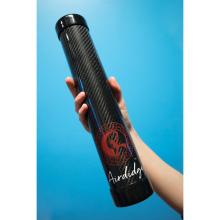
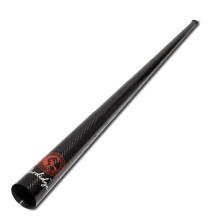
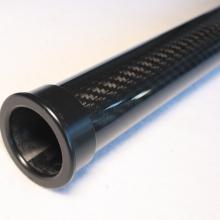
The Airdidge: At 540 g and 37 cm once collapsed, the Airdidge goes everywhere with you. Extended, it is a 186 cm didgeridoo that plays almost effortlessly. Sturdy and elegant, it withstands heat and humidity.
The sound: You play in three keys, B, C# and E, depending on how many sections are extended. The acoustic quality stays excellent at every length. The instrument is very easy to play, with a very comfortable back pressure.
Please note: the Swiss maker lists the notes Bb, C and Eb. This semitone difference depends on your playing pressure: at low pressure you get Bb, C and Eb; at high pressure, "pushing" the didgeridoo (as I do), you land on B, C# and E.
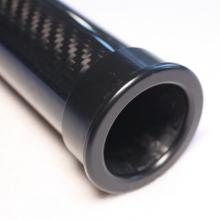
The material: The Airdidge is made of 100% carbon fibre: a reinforced plastic that is very strong and extremely light. It is one of the lightest and most compact didgeridoos on the market. Another advantage: it is easy to clean, with cold water.
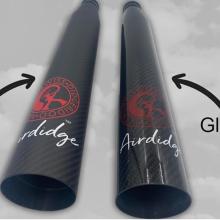
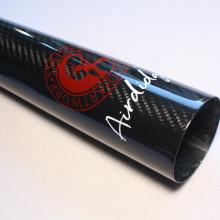
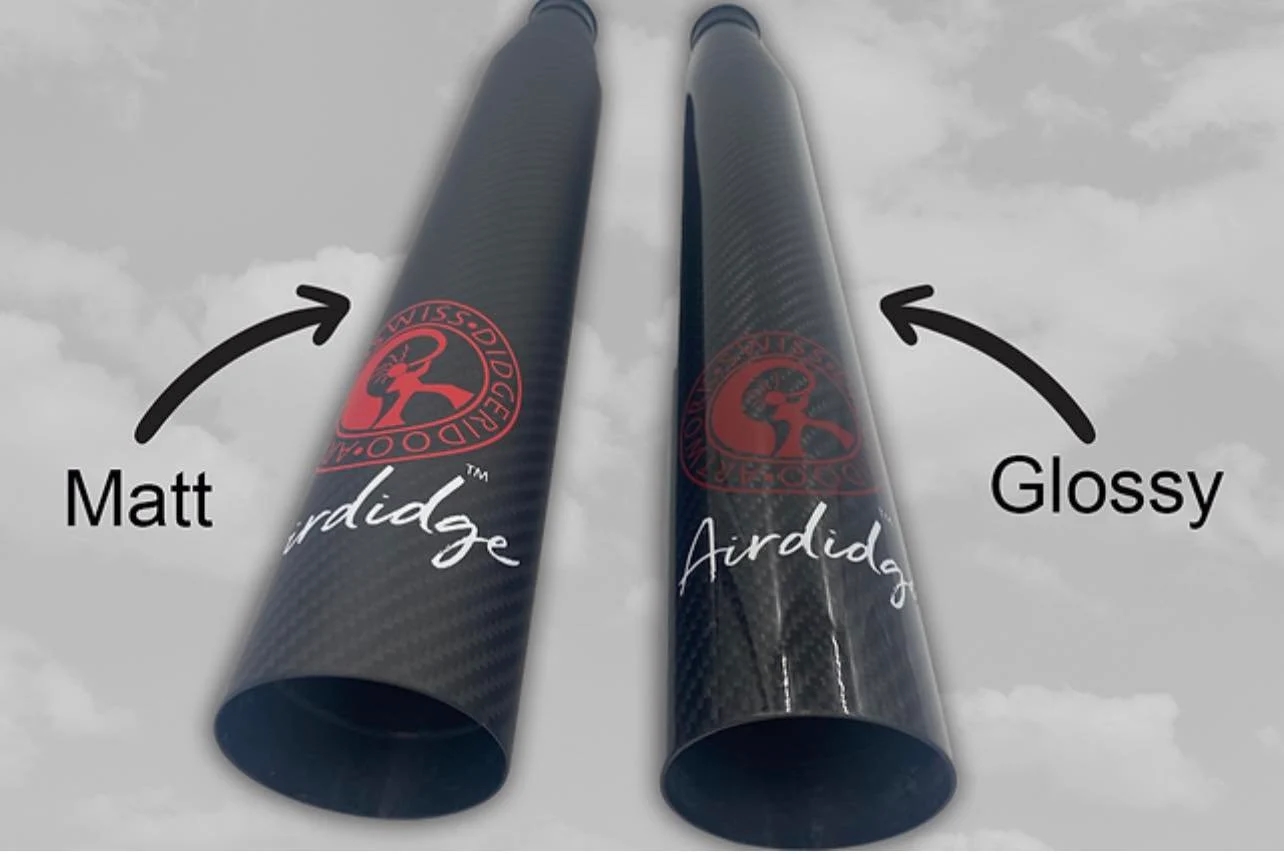
Two finishes available: choose yours just before adding to the cart.
| Weight of the Airdidge alone: | 0.540 kg |
| Weight with protective caps: | 0.650 kg |
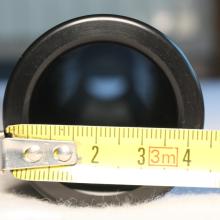
| Mouthpiece diameter: | 3.2 cm |
| Length of the Airdidge extended: | 186 cm |
| Length of the Airdidge collapsed: | 37 cm |
| Airdidge material: | carbon fibre |
My advice: After each use, wipe every part of your Airdidge, inside and out, with the microfibre cloth: the instrument stays clean and you avoid odours. Thanks to Termite Sunny for the video!
The real price, no surprises: My price includes all taxes and import costs. The price shown by the Swiss maker includes neither VAT nor customs fees, which you pay to the courier on delivery. In the end you pay a similar price, with no paperwork and no surprise fees on delivery, plus 14-day returns and my advice.
Classification
This scale is the result of an air column/bell start ratio If we divide the diameter of the bell with that of the beginning of the air column we get a number between 1.5 and 3.5. We can classify all the didgeridoos in 4 large families. Each family groups the instruments with a similar character, simply based on the overall shape of the air column (conical/cylindrical) and on the diameter of the column (wide/narrow). The result is a simple and very reliable reading grid, making it easier to search and purchase on line.
The diameters are measured with a caliper, start of the air column after the mouthpîece. This ratio is very reliable for a didg having a air column with a 'smooth' internal work, in the case of a hollowed eucalyptus instrument it give an approach of the instrumental character.